Look up at the daytime sky on a clear afternoon, and you are greeted by a vast, brilliant blue ceiling stretching from horizon to horizon. Yet when night falls, that same sky transforms into pitch black space filled with twinkling stars. Why isn’t the sky clear like water or black like space during the daytime? Why is it specifically bright blue? Explaining why the sky is blue during the day introduces children to light spectrum physics, atmospheric gas composition, and optical scattering—a phenomenon known to scientists as Rayleigh Scattering.
Sunlight Is Built From a Rainbow of Colors
To understand sky color, children must first discover the secret nature of sunlight.
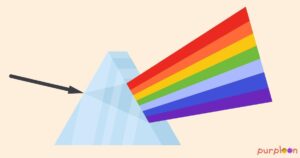
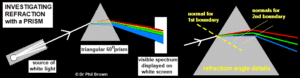
Sunlight Is Composite White Light. Although sunlight entering our eyes appears clear or white, it is actually composed of all the colors of the rainbow mixed together: Red, Orange, Yellow, Green, Blue, Indigo, and Violet (ROYGBIV).
Light Waves and Wavelengths. Sunlight travels through space as electromagnetic waves. Different colors of light have different physical wavelengths:
– Red and Orange Light: Long, lazy wavelengths that travel in wide, relaxed waves.
– Blue and Violet Light: Short, fast, choppy wavelengths that travel in tight, high-energy waves.
Rayleigh Scattering: How Air Gas Molecules Scatter Light
When sunlight completes its 93-million-mile journey across space and enters Earth’s upper atmosphere, it collides with a thick blanket of gas molecules—primarily Nitrogen ($N_2$, 78%) and Oxygen ($O_2$, 21%).
Long Red Waves Pass Straight Through. Long light wavelengths (red, orange, yellow) pass directly through nitrogen and oxygen gas molecules without colliding much, traveling in straight lines down to the ground.
Short Blue Waves Get Bounced Around! Short, choppy light wavelengths (blue and violet) hit tiny nitrogen and oxygen gas molecules and bounce off in every direction! This selective bouncing of short light wavelengths by microscopic gas molecules is called Rayleigh Scattering (named after Lord Rayleigh who discovered the physics in 1871).
The Sky Is Full of Bounced Blue Light. As short blue light waves bounce continuously from gas molecule to gas molecule across the upper atmosphere, they scatter in every direction, filling the entire sky with scattered blue light!
Atmospheric Light Physics Summary Matrix
| Sky Condition / Location | Atmospheric Interaction | Light Scattering Behavior | Resulting Perceived Sky Color |
|---|---|---|---|
| Daytime Midday Sky | Rayleigh Scattering by $N_2$ & $O_2$ gases | Short blue waves scatter in all directions | Bright Sky Blue |
| Sunset / Sunrise Sky | Sunlight travels through 10x thicker air | Blue scatters out; red/orange waves pass through | Brilliant Red, Orange & Pink |
| Outer Space / Moon Sky | Zero atmosphere (Absolute vacuum) | Zero light scattering occurs | Pitch Black (Stars visible) |
| Overcast Cloudy Sky | Water droplets scatter all light wavelengths| Mie Scattering (All colors scatter equally) | White / Dull Gray |
Why Isn’t the Sky Violet?
Curious children may ask a brilliant follow-up question: “If violet light has an even shorter wavelength than blue light, why isn’t the sky violet?”
Two Factors Explain Why We See Blue Instead of Violet:
1. Solar Spectrum Output: Sunlight entering Earth’s atmosphere contains significantly more blue light waves than violet light waves.
2. Human Retina Sensitivity: Human eyes contain light-sensitive cells called cones. Our blue-sensitive retina cones are significantly more sensitive to blue light frequencies than to violet light frequencies, perceiving the scattered light blend as sky blue!
Hands-On Activity: The Milk and Flashlight Sky Demonstration
Demonstrate Rayleigh light scattering on your kitchen counter in 3 minutes!
Materials Needed:
– 1 clear glass container filled with clean water
– 1/2 teaspoon milk
– 1 bright white LED flashlight
– Darkened room
Procedure:
1. Shine the white flashlight through a glass of clean water in a dark room: the light beam passes straight through, appearing white.
2. Add 2 to 3 drops of milk to the water and stir. Milk contains microscopic suspended fat particles that mimic gas molecules in the atmosphere.
3. Shine the flashlight through the milky water. Look at the glass from the side: the water glows a distinct pale sky blue because short blue light is scattering off the milk particles! Look directly through the end facing the light beam: the light appears warm yellow-orange, mimicking a sunset!
Concluding Recommendation
Demonstrate Rayleigh light scattering by shining a white flashlight through a glass of milky water in a dark room, showing how short blue light waves bounce off particles while red light passes straight through.
Evaluating Rayleigh Scattering Across Atmospheric Conditions
Understanding how atmospheric density and moisture impact sky color offers deeper optical physics insights.
Sky Color Variations in High-Altitude Environments. At high mountain elevations, the atmospheric gas layer above is thinner. With fewer gas molecules to scatter sunlight, the sky appears a deeper, darker navy blue compared to sea-level skies.
Why the Moon Has No Blue Sky. On the Moon, there is zero atmosphere and zero gas molecules. Without gas molecules to cause Rayleigh light scattering, the lunar sky appears pitch black even when the Sun is shining brightly overhead!
Evaluating Atmospheric Dynamics: Why Sunsets Turn Red and Orange
Understanding why sunsets display fiery red and orange colors connects directly to Rayleigh scattering physics.
Long Atmospheric Light Paths at Sunset. During sunset and sunrise, the Sun sits low on the horizon, forcing sunlight to travel through a much thicker path of Earth’s atmosphere to reach your eyes.
Blue Light Scatters Out Completely. As sunlight travels through this thick air layer, almost all short blue light waves get scattered away in other directions before reaching your eyes. Long red, orange, and yellow light waves pass straight through without scattering, creating breathtaking red and orange sunsets!
Summary Guidelines for Explaining Sky Color
To demonstrate Rayleigh light scattering and atmospheric physics:
1. Explain Composite White Sunlight: Show how clear sunlight contains all rainbow colors traveling in different wavelengths.
2. Illustrate Blue Wave Bouncing: Describe how short blue light waves bounce off atmospheric nitrogen and oxygen gas molecules.
3. Run the Milky Water Demonstration: Shine a white flashlight through milky water in a dark room to observe scattered blue light.
Evaluating Sky Color Variations Across Planetary Bodies
Comparing Earth’s blue sky to the skies of other solar system planets offers fascinating optical physics insights. On Mars, the thin carbon dioxide atmosphere filled with fine iron oxide dust scatters light differently, creating a butterscotch-pink daytime sky!
Understanding the Science of Atmospheric Light Physics
Exploring Rayleigh light scattering demystifies why the sky is blue during the day. Demonstrating light wave bouncing using simple milky water experiments connects everyday visual observations to fundamental optics and atmospheric science.
Our pick: Thames & Kosmos Light & Optics STEM Experiment Kit or Triangular Glass Prism Set Stack