One of the most classic, universal questions asked by curious young children is: “Why is the sky blue?” Parents often struggle to explain the real scientific answer, resorting to common myths like “the sky reflects the ocean” or “air is naturally light blue.” The true explanation is rooted in atmospheric physics, optical light scattering, and human eye biology. By understanding how sunlight interacts with gas molecules in Earth’s atmosphere—a phenomenon known as Rayleigh Scattering—parents can explain why the sky is blue during the day, why sunsets turn brilliant red and orange, and why the sky appears black on the Moon.
Light Spectrum Basics: Sunlight Is a Rainbow of Colors
To explain sky color to children, begin by discussing the true nature of sunlight.
Sunlight Is Composite White Light. Although sunlight appears clear or white to our eyes, it is actually composed of all the colors of the visible rainbow mixed together: Red, Orange, Yellow, Green, Blue, Indigo, and Violet (ROYGBIV).
Light Travels in Waves. Sunlight travels through space as electromagnetic energy waves. Different colors of light have different wavelengths:
– Red and Orange Light: Long, lazy wavelengths with low energy.
– Blue and Violet Light: Short, fast, choppy wavelengths with high energy.
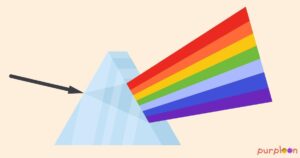
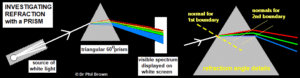
Demonstrating Light Spectrum with a Prism. Passing sunlight through a clear glass prism or water droplet bends (refracts) the light waves, separating white light into its constituent rainbow colors, proving that sunlight contains all visible colors.
Rayleigh Scattering: How Air Molecules Scatter Light
When sunlight reaches Earth’s upper atmosphere, it collides with a thick blanket of invisible gas molecules—primarily Nitrogen ($N_2$, 78%) and Oxygen ($O_2$, 21%).
Short Blue Waves Get Bounced Around. Long light wavelengths (red, orange, yellow) pass directly through gas molecules in the air without colliding much, traveling in straight lines down to the ground. However, short, choppy light wavelengths (blue and violet) hit tiny nitrogen and oxygen gas molecules and bounce off in every direction! This selective scattering of short light wavelengths by tiny atmospheric gas molecules is called Rayleigh Scattering (named after British physicist Lord Rayleigh who discovered it in 1871).
The Sky Is Full of Bounced Blue Light. As blue light bounces continuously from gas molecule to gas molecule across the sky, it fills the entire atmosphere above us with scattered blue light, making the sky appear bright blue from every angle on the ground!
Why Isn’t the Sky Violet? The Human Eye Factor
Curious children may ask a clever follow-up question: “If violet light has an even shorter wavelength than blue light, why isn’t the sky violet?”
Two Factors Explain Why We See Blue Instead of Violet:
1. Solar Energy Output: Sunlight entering Earth’s upper atmosphere contains significantly more blue light than violet light.
2. Human Retina Biology: Human eyes contain light-sensitive photoreceptor cells called cones (Red, Green, and Blue cones). Human retina Blue cones are significantly more sensitive to blue light frequencies than to violet light frequencies, perceiving the scattered light blend as sky blue.
Atmospheric Physics Comparison Table
| Sky Condition / Scenario | Light Wavelength Behavior | Primary Atmospheric Interaction | Perceived Sky Color |
|---|---|---|---|
| Daytime Noon Sky | Short blue waves scatter in all directions | Rayleigh Scattering by $N_2$ and $O_2$ gases | Bright Sky Blue |
| Sunset / Sunrise | Long distance path; blue scatters out | Red/Orange waves pass through thick air | Brilliant Red, Orange & Pink |
| Overcast / Cloudy Sky | All light wavelengths scatter equally | Mie Scattering by large water droplets | White / Dull Gray |
| Moon Sky (No Atmosphere) | Zero light scattering occurs | Absolute Vacuum (No gas molecules) | Pitch Black (Stars Visible) |
Why Are Sunsets Red and Orange?
During sunset and sunrise, the Sun sits low on the horizon. Sunlight must travel through a much longer path of Earth’s atmosphere—nearly 10 times more air—to reach your eyes compared to midday when the Sun is overhead.
Blue Light Scatters Away Completely. As sunlight travels through this thick atmospheric path, almost all short blue and violet light gets scattered out and lost in other directions before reaching your eyes. Long red, orange, and yellow light wavelengths pass straight through the thick air without scattering, creating breathtaking red and orange sunsets!
Why Is the Space Sky Black?
On the Moon or in outer space, there is zero atmosphere and zero gas molecules. Because there are no air molecules to scatter sunlight, the space sky appears pitch black—even when the Sun is shining brightly!
Hands-On Activity: The Milk and Water Sky Experiment
Demonstrate Rayleigh scattering on your kitchen counter in 5 minutes!
Materials Needed:
– 1 clear glass or square glass container filled with clean water
– 1/2 teaspoon of milk (or liquid soap)
– 1 bright white LED flashlight
– Darkened room
Procedure:
1. Shine the white flashlight through the side of the clear water glass in a dark room. Observe that the light beam passes straight through, appearing clear/white.
2. Add 2 to 3 drops of milk to the water and stir gently. Milk contains tiny suspended fat and protein particles that mimic gas molecules in the atmosphere.
3. Shine the flashlight through the milky water again. Look at the glass from the side: the liquid glows a distinct pale sky blue because short blue light is scattering off the milk particles!
4. Look directly through the end of the glass facing the flashlight beam: the light appears warm yellow and red—just like a sunset!
Concluding Recommendation
Explain why the sky is blue by conducting the milk-and-water scattering experiment in a dark room, demonstrating how short blue light waves bounce off tiny particles while red sunset light passes straight through.
Why Clouds Appear White While the Sky Is Blue
A common follow-up question children ask when studying the sky is why fluffy clouds appear bright white against a blue sky background.
Mie Scattering in Cloud Droplets. Unlike atmospheric gas molecules which are tiny compared to light wavelengths, water droplets inside fluffy clouds are much larger than visible light wavelengths. When sunlight strikes large cloud water droplets, all colors of visible light scatter equally in every direction—a process called Mie Scattering. Because all visible light colors scatter equally, the reflected light recombines into bright white!
Conducting simple light scattering experiments at home helps children understand Rayleigh scattering, atmospheric physics, and sunset optics.
Understanding how light waves interact with air molecules turns a classic childhood question into an exciting journey through optical physics.
Exploring light refraction and scattering with household prisms provides an engaging, memorable foundation for scientific learning.
Answering curious questions about nature builds lifelong scientific curiosity and critical thinking skills.
Our pick: Thames & Kosmos Optics & Light Science Kit or Glass Triangular Prism Stack