Lots of grown-ups think little kids are “too young” for math — that you need flashcards, worksheets, and a quiet table to begin. But guess what? One of the best math classrooms in the world is full of bananas, beeping scanners, and squeaky trolley wheels. Yep — the grocery store! Let’s bust some big myths about teaching math to young children.
Myth #1: Kids Need Numbers on Paper First
Myth #2: Shopping Math Is Just Counting
Myth #3: It Has to Feel Like a Lesson
So What’s Actually True?
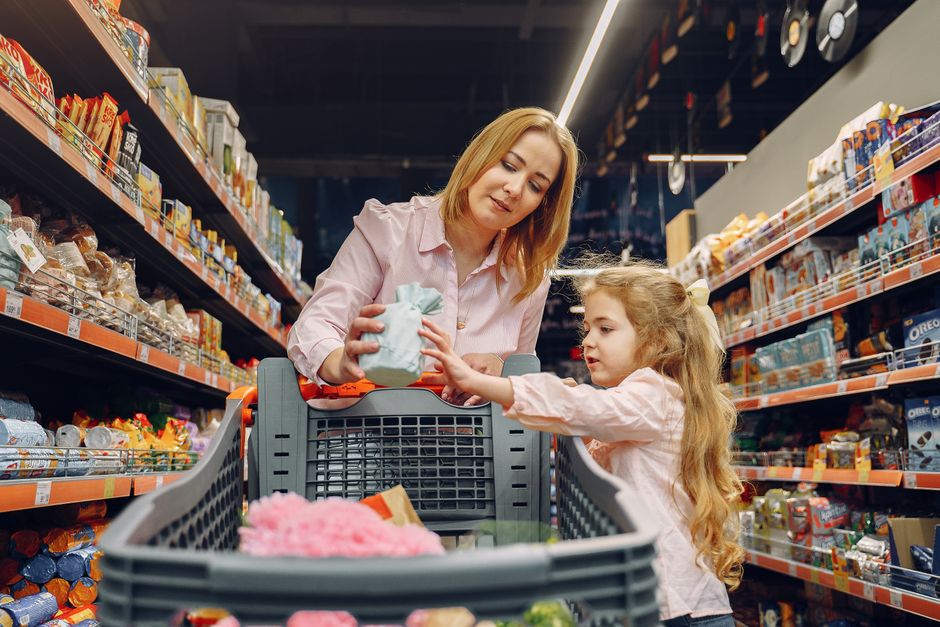
Young children are natural mathematicians — they just learn through play, not paperwork. A trip to the shops is full of counting, sorting, comparing, and shape-spotting, and your child barely notices they’re “doing math” at all. The trick is to ask gentle, playful questions and let them touch, point, and count out loud. Little wins build big confidence!
🌟 Did You Know?
Counting out loud while pointing to each item is called one-to-one matching. It’s one of the very first and most important math skills — and a basket of apples is the perfect place to practise it!
The Building Blocks of Early Math
Long before big-school sums, young children build a handful of key foundations — and the shops are perfect for every one of them:
- 🔢 Counting & number sense — how many? which has more?
- 📏 Measuring & comparing — bigger/smaller, heavier/lighter, longer/shorter.
- 🔴 Shapes — spotting circles, squares, and rectangles on boxes and tins.
- 🔁 Patterns — red-green-red-green apples, or the tiles on the floor.
- 🗂️ Sorting — grouping things by colour, type, or size.
Here’s something amazing: a child’s early number skills are one of the very best clues to how they’ll do in maths for years to come — so these little shop games really matter!
📖 Big Word: Number Sense
An early feel for numbers — knowing what “three” means, which pile has more, and how counting works. It’s the foundation the rest of maths is built on.
The Magic of “Math Talk”
One of the most powerful things a grown-up can do is simply talk about numbers and shapes in everyday life — counting the steps, naming the shapes, comparing the sizes. Researchers have found that children who hear more of this “math talk” at home tend to build stronger maths skills — and even small amounts make a big difference! The best part? You don’t need to be a maths whiz at all. Just wonder out loud together: “How many apples shall we get? Which one’s the biggest? What shape is this tin?”
Grocery Math Games to Try
- 🍎 Counting basket: “Can you put 5 apples in the bag?”
- ⚖️ Guess the weight: hold two items, guess which is heavier, then check.
- 🔺 Shape hunt: find 3 circles and 2 rectangles on the shelves.
- 🎨 Colour sort: gather all the red fruit together.
- 🔢 Number spotting: find the number 2 on the price signs.
- 🛒 Small-to-big line-up: order three tins from smallest to biggest.
A tip for grown-ups: keep it light, cheer every try, and follow whatever catches your child’s eye. Fun is what makes the learning stick.
🔍 Bust the Myth — Tap to Reveal!
Frequently Asked Questions
Q: Isn’t my child too young for maths?
Not at all! Young children are natural mathematicians — they learn through touching, counting, and playing, long before any pencil or worksheet.
Q: What maths can we do at the grocery store?
Loads: counting items, comparing sizes and weights, spotting shapes, finding patterns, and sorting by colour — all before you reach the till.
Q: What is number sense?
An early feel for numbers — knowing what “three” means and which group has more. It’s the foundation for all later maths.
Q: What is “math talk”?
Simply chatting about numbers, shapes, and sizes in daily life. Children who hear more of it tend to build stronger maths skills.
Q: Do I need to be good at maths to help?
No! Just wonder out loud together — “how many?”, “which is bigger?” — and keep it playful.
📚 Where we learned this (for curious grown-ups):
• ZERO TO THREE — Help Your Child Develop Early Math Skills
• NAEYC — Math Talk with Young Children
• DREME (Stanford) — Family Math
Now You Know!
Your child doesn’t need to wait for “big school” to fall in love with numbers. Next time you push the trolley down the aisle, toss in a tiny math game or two. Count the carrots, compare the melons, hunt for circles — and watch your little mathematician shine. Happy shopping!