Squish a little soap and water between your hands, give a puff, and — pop! — out floats a shimmering, see–through ball. But plain water won’t do that, no matter how hard you try. So what is soap secretly doing to turn ordinary water into a bubble machine?
So why won’t plain water make bubbles?
Water molecules really love holding hands with each other. They pull together so tightly that the surface of water acts like a stretchy, invisible skin — we call this surface tension. When you try to blow a bubble with plain water, that skin is far too strong and grippy. Instead of stretching out thin and round, it just snaps shut. No bubble.
📖 Big Word: Surface Tension
The way water’s top acts like a thin, stretchy skin because the tiny water bits pull tightly toward each other.
Then what does the soap change?
Soap is a clever in–betweener. Each soap molecule has one end that loves water and one end that pushes water away. When you mix soap in, these molecules wedge themselves between the water bits, loosening their tight grip on each other. The skin becomes softer and far more stretchy — now it can pull thinner and thinner without snapping. That stretchy soapy skin is exactly what a bubble is made of.
So why is a bubble always round?
Here’s the neat bit: even after soap relaxes the water, the skin still wants to pull itself as small and tidy as possible. The shape that wraps the most air using the least amount of skin is… a sphere — a perfect ball. So no matter what shape your bubble wand is, square or star, the bubble always rounds itself into a ball as it floats free.
🌟 Did You Know?
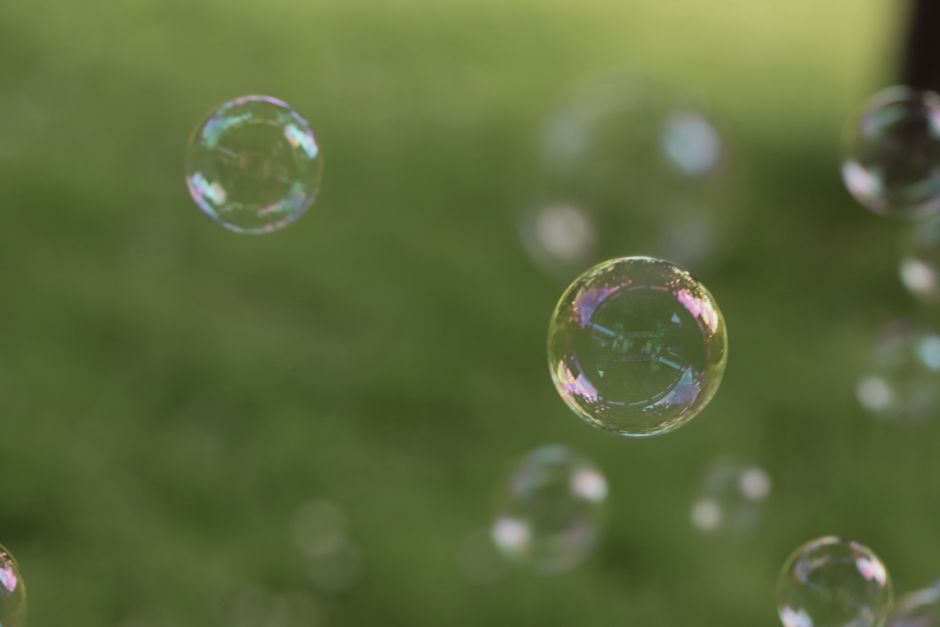
A soap bubble’s wall is unbelievably thin — far thinner than a human hair. Those swirling rainbow colours come from light bouncing off both sides of that super–thin skin at once!
Then why do bubbles pop?
A bubble is really a thin layer of water trapped between two layers of soap, like a watery sandwich. As it floats, the water slowly dries away into the air, and the skin gets thinner and thinner until it can’t hold together — pop! Touch a bubble with a dry finger and you pop it instantly, but a wet, soapy finger can sometimes slide right through without bursting it.
🔍 Tap to Reveal!
The Secret Recipe for Giant, Longer–Lasting Bubbles
Ever wonder why a professional bubble artist can make bubbles the size of a beach ball that float for ages, while yours pop in seconds? The trick isn’t magic — it’s a helper ingredient. Stir in a spoonful of glycerin (or sticky corn syrup) with your dish soap and water, and your bubbles will grow bigger and survive much longer.
📖 Big Word: Evaporation
This is when water quietly turns into invisible vapour and drifts away into the air — it’s exactly what slowly thins out a bubble’s watery skin until it pops.
Remember that a bubble is a super–thin sandwich of water, and it pops the moment that water dries up into the air. Glycerin molecules grab onto the water molecules and hold them close, which slows down evaporation so the skin stays wet (and stretchy) for much longer. That’s the whole secret behind giant, record–setting bubbles.
Where Do Those Swirling Rainbow Colours Come From?
Look closely at a floating bubble and you’ll see shimmering swirls of purple, green, and gold sliding across its skin. That light show has a name: thin–film interference. Light bounces off the outside of the soapy skin and off the inside of it, and those two bounced beams of light overlap on their way back to your eyes. Depending on exactly how thick the skin is at that spot, some colours of light line up and glow brighter while others cancel each other out and disappear.
📖 Big Word: Thin–Film Interference
What happens when light bounces off both sides of a super–thin layer (like a bubble’s skin) and the reflections mix together, making some colours brighter and others vanish.
Gravity also plays a part: it slowly pulls the watery skin downward, making the top of the bubble thinner than the bottom. Since the thickness keeps changing from top to bottom, the colours keep sliding and swirling too — which is why a bubble never looks the same twice, right up until the moment it pops.
Just How Giant (or Icy) Can a Bubble Get?
Bubble artists have turned this simple kitchen science into jaw–dropping records. The largest free–floating soap bubble ever measured was bigger than a small car — about 96 cubic metres of air wrapped in a skin thinner than a hair! And bubbles have a chilly trick too: on a very cold day (well below freezing), the water inside a bubble’s skin can freeze solid before it pops, leaving a fragile, crackling ice ball with frost patterns racing across it like a tiny snow globe.
🌟 Did You Know?
A giant outdoor bubble once measured about 96 m³ — roomy enough to fit a small car inside! And on a freezing day, you can sometimes watch tiny ice crystals race across a bubble’s skin just before it turns into a delicate ball of ice.
Frequently Asked Questions
Q: Why doesn’t plain water make bubbles?
Water’s surface tension is too strong and snaps shut instead of stretching. Soap loosens that grip so the skin can stretch thin without breaking.
Q: Why is every soap bubble round?
The stretchy skin always shrinks to the smallest shape it can hold — and a sphere is the roundest, most space-efficient shape there is.
Q: How can I make my bubbles bigger and longer-lasting?
Add a spoonful of glycerin or corn syrup to your soap-and-water mix. It slows down evaporation, so the wet skin survives much longer before popping.
Q: What makes the rainbow swirls on a bubble?
It’s called thin-film interference — light bounces off both sides of the soapy skin and mixes together, making some colours glow and others vanish.
Q: Can a soap bubble really freeze?
Yes! On a very cold day, the watery layer inside the bubble’s skin can freeze solid, leaving a fragile ball of ice with frost patterns racing across it.
📚 Where we learned this (for curious grown-ups):
• Scientific American — Blow the Best Bubbles (glycerin & evaporation)
• Explain that Stuff — Thin-Film Interference (why bubbles are rainbow-coloured)
• National Geographic — How Frozen Bubbles Work
• Guinness World Records — Largest Free-Floating Soap Bubble
Now You Know!
Soap doesn’t magically create bubbles — it gently loosens water’s tight grip so the surface can stretch into a thin, see–through ball. So the next time you blow a stream of glittering bubbles, you’re really watching soap, water, and air work together in a tiny, beautiful science trick. Give it a puff and see how big you can make one!