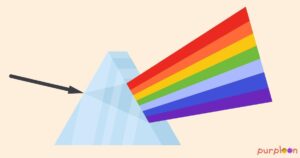
Did you know there is a hidden rainbow tucked inside every beam of sunshine? You can’t see it… until you give that light a little nudge. With one glass of water and a small mirror, you can pull all seven rainbow colours right out of the sunlight in your own kitchen. Ready, little scientist? Let’s catch a rainbow!
🧪 What You Need
- A clear drinking glass
- Water
- A small flat mirror
- A sheet of white paper
- A sunny window
- A grown-up helper
Let’s Build It — Step by Step
⚠️ Stay Safe
Never look straight at the Sun — it can hurt your eyes. Let the sunlight bounce onto the paper instead. Glass and water can be slippery, so carry your glass slowly and keep a grown-up close by.
What’s Going On?
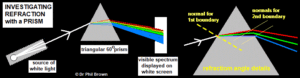
Sunlight looks plain white, but it is actually a secret bundle of many colours all travelling together. When light zooms from the air into the water, it slows down and bends — scientists call this bending refraction. Here’s the magic part: each colour bends by a slightly different amount. Red bends the least and violet bends the most.
Because the colours bend by different amounts, they spread out and fan apart, like racers spreading across a track. The mirror then bounces that fanned-out light onto your paper, so you finally see all the colours lined up in order: red, orange, yellow, green, blue, indigo, and violet. Your glass of water just worked like a tiny prism!
📖 Big Word: Refraction
When light bends as it passes from one thing into another, like from air into water. That bending is what splits white light into a rainbow.
🌟 Did You Know?
A real rainbow in the sky works the same way! Millions of tiny raindrops each bend and split the sunlight, and together they paint a giant arc across the clouds.
Why Each Colour Bends a Different Amount
White light is a bundle of colours, and each colour travels as a different size of light wave (its wavelength). When the light bends going into the water, each size bends by a slightly different amount: red has the longest wave and bends the least, while violet has the shortest wave and bends the most. So they fan apart into the full band of colours — called a spectrum. Long ago, the scientist Isaac Newton proved sunlight is all these colours mixed together: he split a sunbeam with a glass prism, then used a second prism to blend the colours right back into white light!
📖 Big Word: Spectrum
Say it “SPECK-trum.” It’s the full band of colours hidden inside white light — red, orange, yellow, green, blue, indigo, and violet — the same order you see in a rainbow.
How a Real Rainbow Forms in the Sky
Want to spot a rainbow outside? You need the Sun behind you and rain or mist in front of you. Then every tiny raindrop acts like a little prism and mirror at once: sunlight bends as it goes into the drop, bounces off the back, and bends again coming out — splitting into colours each time. Millions of drops working together paint the giant arc, always in the same order, with red on the outside and violet on the inside. That’s also why a rainbow always sits about opposite the Sun, around the shadow of your own head!
Rainbow Surprises
Rainbows are full of secrets:
- 🌈🌈 Double rainbows happen when light bounces twice inside the drops — making a second, fainter bow above the first with its colours reversed.
- 🏃 You can never reach the end of a rainbow — it isn’t in a fixed spot, so it moves along with you as you walk!
- 💦 Make your own with a garden hose or find one by a waterfall — and on a bright night, a rare glowing “moonbow” can appear.
- 👀 Hidden colours: sunlight also carries light your eyes can’t see — warm infrared just past red, and ultraviolet past violet (which bees can see!).
🔍 Tap to Reveal!
Frequently Asked Questions
Q: How does a glass of water make a rainbow?
Sunlight bends as it enters the water (refraction), and each colour bends a different amount, so they fan apart into a rainbow — the glass works like a tiny prism.
Q: Why does white light split into colours?
White light is really all the rainbow colours mixed. Each colour is a different-sized light wave that bends by a different amount, so they spread out into a spectrum.
Q: Which colour bends the most?
Violet bends the most and red bends the least, which is why red is always on the outside of a rainbow and violet on the inside.
Q: How does a real rainbow form?
With the Sun behind you and rain in front, each raindrop bends, reflects, and bends the light again, splitting it into colours. Millions of drops make the arc.
Q: What is a double rainbow?
A fainter second bow that appears when light bounces twice inside the raindrops — its colours are reversed compared to the main rainbow.
📚 Where we learned this (for curious grown-ups):
• NOAA — What Causes a Rainbow?
• NASA — Visible Light & the Spectrum
• Britannica — What Causes a Rainbow?
You Did It! 🎉
You bent sunlight and caught a rainbow with just a glass of water — how cool is that? Now be a true scientist and change one thing: what if you use a bigger glass, more water, or a brighter window? Does your rainbow grow longer, brighter, or land in a new spot? Keep tilting, keep wondering, and keep chasing those colours!