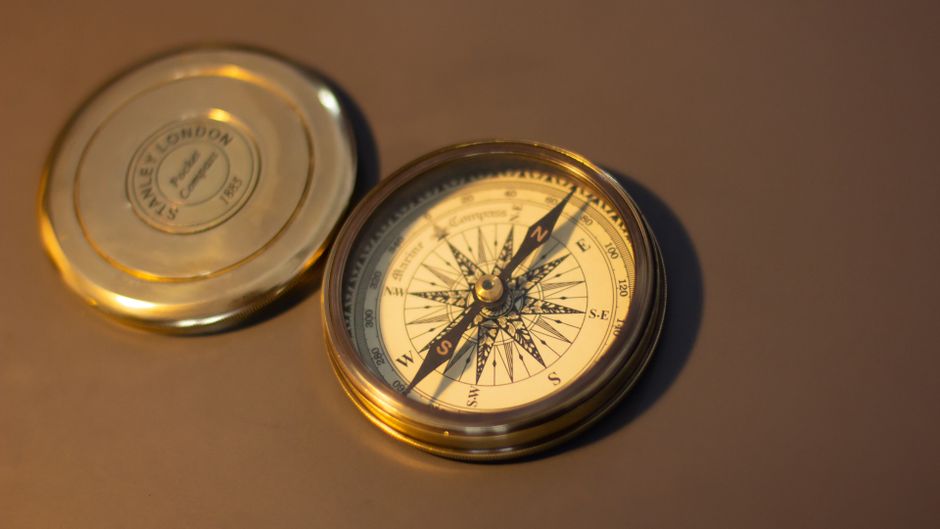
Did you know you can build a tool that always points the same way — using a needle, a magnet, and a bowl of water? Long before phones and maps, explorers crossed huge oceans with a simple magnetic compass. Today you get to make one on your kitchen table.
🧪 What You Need
- 1 sewing needle
- A fridge magnet
- A small piece of cork or foam
- A bowl of water
- Scissors (with a grown-up)
- A little patience!


Let’s Build It, Step by Step
⚠️ Stay Safe
Needles are sharp and magnets should never go near your mouth or ears. Always have a grown-up help with the scissors and the needle, and keep magnets away from younger brothers and sisters.
What’s Going On?
Stroking the needle with a magnet lines up tiny invisible parts inside the metal called magnetic domains. When they all face the same way, the whole needle turns into a weak magnet of its own. Floating it on cork lets it spin freely without any rubbing to slow it down.
Here is the amazing part: the Earth itself is like a giant magnet, with a magnetic pull near the top and the bottom of our planet. Your little needle simply turns until it lines up with the Earth’s invisible magnetic field — just like two magnets snapping into place. That is how it finds north, anywhere on the planet.
🤯 Whoa, Really?!
The Earth’s magnetic north slowly drifts and wanders a little every year, so the exact spot it points to today is not quite where it was when your grandparents were young!
Earth’s Hidden Magnet: The Spinning Core
Your needle points north because the whole planet is a giant magnet — but where does that magnetism come from? Deep down, about 1,800 miles beneath your feet, Earth has an outer core made of super-hot liquid iron. That molten metal is always churning and swirling, and moving metal works just like a giant electric generator, creating Earth’s magnetism. Scientists call this engine the geodynamo. The magnetic field it makes reaches far out into space and even acts like an invisible shield, protecting us from harmful particles blasting off the Sun. Your little needle simply lines up with this enormous field.
📖 Big Word: Magnetic Field
The invisible area of push-and-pull around a magnet. Earth has a giant one, made by its swirling liquid-iron core, and a compass needle turns to line up with it.
Magnetic North Isn’t the “Real” North!
Here’s a brain-bender: your compass points to magnetic north, which is not quite the same spot as the North Pole on a map (called true north). The gap between the two even has a name — declination — and it’s different depending on where in the world you’re standing. That’s why careful explorers and pilots make a little correction. And it gets wilder: magnetic north slowly wanders a bit every year, and over millions of years Earth’s magnetic field has completely flipped — north swapping with south — many times. Ancient rocks still hold the record of those flips!
Animals With Built-In Compasses
You’re not the only one who can find north — lots of animals can sense Earth’s magnetic field and use it like an invisible map! Migrating birds, salmon, and sea turtles all navigate this way, travelling thousands of miles across open ocean or sky. Amazingly, a sea turtle can even find its way back to the exact beach where it hatched, years later, by reading the magnetic field. Scientists think tiny specks of a naturally magnetic mineral inside these animals help them feel it. So your floating needle is doing by hand what these incredible travellers do all by themselves!
🧠 Quick Quiz — tap an answer!
1. Why should you stroke the needle in only one direction?
2. What is the needle lining up with when it points north?
Frequently Asked Questions
Q: How does a compass find north?
The magnetised needle turns until it lines up with Earth’s huge magnetic field — just like two magnets snapping into place — and one end ends up pointing roughly north.
Q: Why is the Earth magnetic?
Deep inside, Earth’s outer core is churning liquid iron. That swirling metal works like a giant generator (the geodynamo) that creates the planet’s magnetic field.
Q: Is magnetic north the same as the North Pole?
Not exactly! A compass points to magnetic north, which is a slightly different, slowly-wandering spot from the map’s North Pole (true north). The gap is called declination.
Q: Does Earth’s magnetic field ever change?
Yes — magnetic north drifts a little each year, and over millions of years the whole field has flipped north-for-south many times.
Q: Can animals sense magnetic fields?
Yes! Birds, salmon, and sea turtles use Earth’s magnetic field to navigate huge distances — a turtle can even find the beach where it hatched.
📚 Where we learned this (for curious grown-ups):
• NASA — Earth’s Magnetic Field & the Churning Core
• USGS — What Is Declination? (Magnetic vs True North)
• USGS — Do Animals Use the Magnetic Field to Navigate?
You Did It!
You just built a real working compass from scratch — the same kind of tool sailors trusted for hundreds of years. Now try changing one thing: what happens if you use a bigger magnet, stroke the needle more times, or float it in a deeper bowl? Test it, watch closely, and become a real explorer!