Transforming kitchen pantry ingredients into sparkling, translucent crystal sun-catchers is a breathtaking STEM project that combines chemistry, geology, optics, and art. Hanging in a sunny bedroom window, crystal sun-catchers catch sunlight and cast brilliant, refracting light beams across the room. Yet beyond their artistic beauty, growing crystals provides a captivating hands-on lesson in supersaturated solution chemistry, molecular crystallization, and mineral lattice formation. In this guided science project, children grow real Epsom salt or Borax crystal formations on colorful pipe cleaner shapes in just 24 hours!
The Chemistry of Crystal Growth: Supersaturated Solutions
To understand how crystals grow overnight, children must explore how temperature affects liquid solubility.
Solubility and Molecular Dissolution. When you stir salt or sugar into room-temperature water, the solid mineral dissolves into invisible individual ions. Water molecules ($H_2O$) surround the mineral ions, holding them apart in a liquid solution. Room-temperature water can only hold a limited amount of dissolved solute before reaching its “saturation point.”
Creating a Supersaturated Solution With Heat. Thermal heat causes water molecules to expand and move rapidly, creating extra microscopic space between liquid molecules. Heating water to near-boiling temperatures allows it to dissolve twice as much mineral salt as room-temperature water, creating a highly concentrated supersaturated solution.
Crystallization via Cooling and Evaporation. As the hot supersaturated water cools down to room temperature, the water molecules contract and slow down. The water can no longer hold the excess dissolved minerals! Dissolved mineral ions are forced out of the liquid phase, bonding together in repeating, three-dimensional geometric patterns known as a crystal lattice.
Crystal Growing Chemistry Method Comparison Matrix
| Crystal Mineral Type | Primary Chemical Compound | Cooling / Growth Duration | Crystal Shape & Structure | Parent Safety Level |
|---|---|---|---|---|
| Epsom Salt Crystals | Magnesium Sulfate ($MgSO_4$) | Fast (12 to 24 Hours in Fridge) | Delicate, needle-like acicular crystals | 100% Safe (Non-toxic bath salt) |
| Borax Crystals | Sodium Tetraborate ($Na_2B_4O_7$) | Fast (12 to 24 Hours at Room Temp) | Large, sturdy hexagonal prisms | Safe with supervision (Do not ingest) |
| Table Salt Crystals | Sodium Chloride ($NaCl$) | Slow (3 to 7 Days via Evaporation) | Perfect cubic geometric blocks | 100% Safe (Edible kitchen salt) |
| Sugar Crystals (Rock Candy) | Sucrose ($C_{12}H_{22}O_{11}$) | Slow (7 to 14 Days via Evaporation) | Large, sweet edible crystal clusters | 100% Safe (Edible confection) |
Step-by-Step Guide: Making Borax Crystal Sun-Catchers
Follow these structured instructions to grow durable, sparkling Borax crystal sun-catchers overnight.
Materials Required:
– 3 tablespoons Borax powder (Sodium Tetraborate, found in the laundry aisle) per 1 cup boiling water
– 2 cups boiling water (handled strictly by an adult)
– Fuzzy chenille pipe cleaners (bright colors)
– Wide-mouth glass mason jar
– Pencil or wooden popsicle stick
– String or thin yarn
– Scissors
Step 1: Shape the Sun-Catcher Base. Bend colorful pipe cleaners into fun decorative shapes—such as stars, hearts, snowflakes, or circles. Ensure the pipe cleaner shape is small enough to fit inside the wide-mouth glass jar without touching the bottom or sides!
Step 2: Suspend the Shape. Tie one end of a string to the top of your pipe cleaner shape, and tie the other end around a pencil. Rest the pencil horizontally across the top rim of the glass jar so the pipe cleaner shape hangs suspended in the center of the jar.
Step 3: Prepare the Supersaturated Solution. An adult boils 2 cups of water. Pour boiling water into the glass jar. Add 6 tablespoons of Borax powder (3 tablespoons per cup of water) and stir thoroughly until the powder dissolves completely and the liquid appears clear.
Step 4: Submerge and Wait. Lower the suspended pipe cleaner shape into the hot Borax solution. Place the jar in a quiet room where it will not be bumped or disturbed. As the solution cools over the next 12 to 24 hours, thick sparkling Borax crystals will precipitate out of liquid and bond to the fuzzy pipe cleaner fibers!
Step 5: Hang in a Sunny Window. Gently remove the crystal-coated shape from the jar, pat dry on a paper towel, and tie a hanging ribbon to the top. Hang your new crystal sun-catcher in a sunny window to observe refracting sunlight!
Concluding Recommendation
Grow sparkling Borax crystal sun-catchers overnight with your child, hanging them in a sunny window to explore supersaturated solution chemistry, mineral crystallization, and optical refraction.
Evaluating Seed Crystal Nucleation Mechanics
Understanding how crystal structures initiate bonding requires analyzing nucleation sites.
Nucleation Site Physics. Dissolved mineral ions in a supersaturated solution need a physical surface anchor to begin bonding together into a solid crystal lattice. The microscopic fuzzy fibers of chenille pipe cleaners provide thousands of ideal nucleation sites, allowing Borax or Epsom salt crystals to form rapidly overnight.
Comparing Epsom Salt Needle Crystals to Borax Prisms. Epsom salt (Magnesium Sulfate, $MgSO_4$) forms long, delicate needle-like monoclinic crystals, while Borax (Sodium Tetraborate) forms large, sturdy, blocky hexagonal prisms. Comparing both crystal types under a magnifying glass introduces children to mineralogy and geometric crystal systems.
Evaluating Temperature Control and Crystallization Speed
Temperature control plays a critical role in determining the physical size and clarity of grown crystals.
Fast Cooling vs Slow Cooling Crystal Formation. Rapid cooling (such as placing a supersaturated crystal jar directly into a cold refrigerator) forces mineral ions to bond together quickly, producing millions of tiny, delicate needle-like crystals. Slow, gradual cooling at room temperature gives mineral ions time to align into large, sturdy, perfectly formed geometric crystal faces.
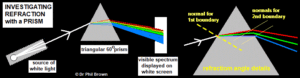
Observing Light Refraction in Window Sun-Catchers. When completed Borax or Epsom crystal sun-catchers hang in direct sunlight, the microscopic geometric crystal planes refract incoming light rays, casting brilliant sparkling light reflections across bedroom walls.
Summary Guidelines for Growing Crystal Sun-Catchers
To ensure a successful supersaturated crystal growing project:
1. Create a Hot Supersaturated Solution: Dissolve Borax or Epsom salt into near-boiling water until no more powder will dissolve.
2. Provide Fuzzy Nucleation Surfaces: Suspend fuzzy pipe cleaner shapes in the solution to give mineral ions ideal bonding anchors.
3. Allow Undisturbed Cooling: Keep the crystal jar in a quiet room for 12 to 24 hours to foster sturdy geometric crystal growth.
Evaluating Crystal Lattice Systems in Geology and Mineralogy
Exploring crystal geometry introduces children to earth science and mineralogy. Natural gemstones—such as quartz, amethyst, diamonds, and emeralds—form through identical geological crystallization processes underground over thousands of years, as superheated mineral-rich fluids cool beneath the Earth’s crust.
Growing sparkling crystal sun-catchers at home provides a memorable hands-on chemistry project that connects supersaturated solutions to mineral geology.
Growing crystals turns basic chemistry into an exciting visual discovery.
Our pick: National Geographic Mega Crystal Growing Lab or DIY Borax Sun-Catcher Science Kit Stack